
When sourcing cosmetic raw materials, skincare brands often face a critical decision: should they work directly with a manufacturer or go through a trading company?
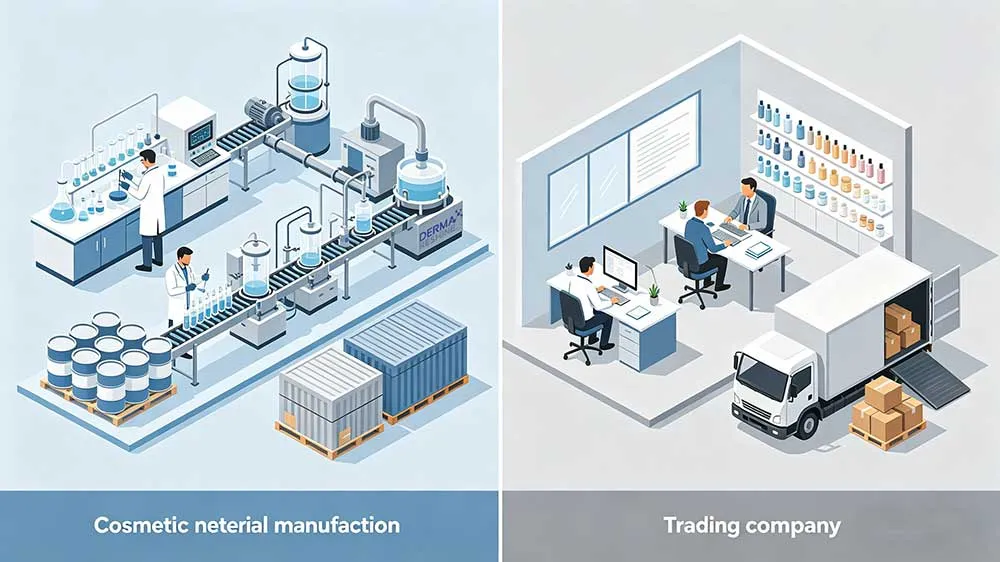
This decision has a direct impact on product quality, formulation consistency, and long-term supply stability. For brands operating in the US market, choosing the right supplier type is not just about cost — it is about reducing supply chain risk.
A cosmetic raw material manufacturer produces ingredients in-house. This allows full control over production processes, quality standards, and raw material sourcing. As a result, manufacturers are able to maintain consistent quality across batches, which is essential for skincare formulations that require stable performance.
In contrast, trading companies act as intermediaries. They source products from different factories and resell them to buyers. While this model can offer convenience, it often introduces uncertainty. Since traders depend on multiple upstream suppliers, consistency in quality and supply can vary over time.
For cosmetic brands, especially those scaling production, even small variations in raw materials can lead to changes in product texture, stability, or effectiveness. This is why many professional buyers prefer to work directly with manufacturers rather than intermediaries.
Another key difference is technical and regulatory support. Manufacturers typically provide complete documentation such as COA, MSDS, and product specifications, along with deeper knowledge of ingredient performance in formulations. This is particularly important for brands that need to meet US and international compliance requirements.
Manufacturers are also better positioned to support OEM and private label projects. With direct production capabilities, they can assist in formulation development, customization, and long-term supply planning.

Derma Reshine operates as a cosmetic raw material manufacturer with its own production system and quality control process. We focus on the development and manufacturing of functional cosmetic ingredients, including Alpha Arbutin, Beta Arbutin, and other active materials used in skincare formulations.
By controlling production internally, we are able to ensure consistent quality, stable bulk supply, and reliable support for global skincare brands. This manufacturing-based approach allows us to work closely with clients on long-term supply and product development needs.
Ultimately, the choice between a manufacturer and a trading company depends on your priorities. If your business requires stable quality, scalable production, and direct technical support, working with a manufacturer is the more reliable option.
For brands looking to build a dependable supply chain, partnering with an experienced cosmetic raw material manufacturer can significantly improve both product consistency and operational efficiency.
For bulk orders, technical documentation, or sample requests, you can contact the Derma Reshine team for further information.